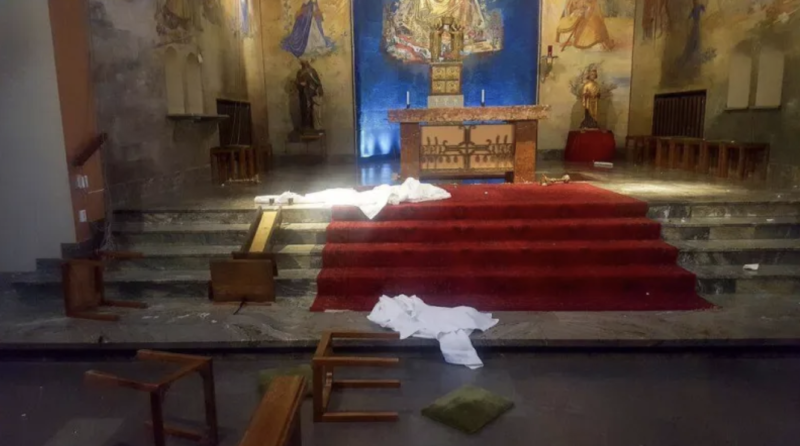
(Photo: Diocese of Stockholm)
On Monday, 23 February 2026, the Commission of the Bishops’ Conferences of the European Union (COMECE) warmly welcomed the recent EP Resolution urging the European Commission to appoint a Coordinator to combat anti-Christian hatred in the European Union. This strong call also reflects the high level of priority COMECE has attached to this issue in recent years. Read the Resolution
Paragraph 84 of the Resolution on ‘Human rights and democracy in the world and the European Union’s policy on the matter – Annual report 2025’ regrets that “…while Christianity remains the most persecuted religion in the world today, with more than 380 million people affected, there is no European coordinator responsible for combating Christianophobia, even though a coordinator has been appointed to combat Islamophobia”.
Taking note of this important statement by the European Parliament, COMECE encourages the European Commission to give serious consideration to the appointment of an EU Coordinator responsible for this field.
The EU bishops, suggest that the title of the future EU Coordinator should refer to ‘anti-Christian hatred’, rather than ‘Christianophobia’, in order to ensure coherence with similar, already existing positions at EU level, in particular the one concerning Muslim communities, as well as to avoid basing such initiatives on the controversial concept of ‘phobia’. The future EU Coordinator should be tasked with addressing concrete cases of discrimination, intolerance and violence against Christian communities in the European Union.
COMECE highlights that to make this protection tangible, “it is essential to also provide financial support for combating anti-Christian hatred in the EU by fully integrating it into the legislative text of the new ‘AgoraEU’ funding instrument”.
The path towards the EP Resolution
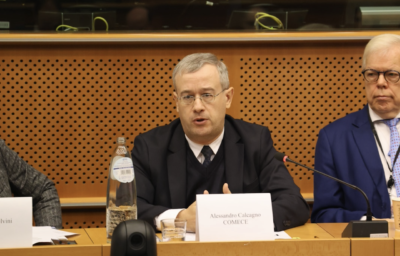
COMECE Adviser, Alessandro Calcagno. Brussels, November 2025. (Photo: COMECE)
During a high-level conference held at the European Parliament in December 2024, COMECE adviser Alessandro Calcagno stated: “The time is ripe for the appointment of an EU Coordinator to combat anti-Christian hatred.” This marked the first time the issue had been formally raised in the EU context.
In October 2025, during the COMECE Assembly, the EU bishops reiterated this request to responsible EUCommissioner Magnus Brunner, who attended as a guest speaker.
In November 2025, at the annual high-level meeting between the EU and religious leaders organised by the European Commission, COMECE Vice-President, Mgr Czeslaw Kozon, called for stronger institutional action, including “the appointment of an EU Coordinator to combat anti-Christian hatred and the urgent need to improve religious literacy”.
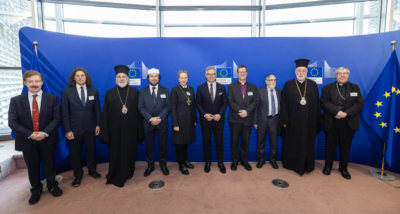
Annual Article 17 TFEU meeting between the European Commission and religious leaders. The photo includes: Commissioner Magnus Brunner and COMECE Vice-President Mgr. Czeslaw Kozon. Brussels, 17 Nov 2025. (Photo: EC- Audiovisual Service/Lukasz Kobus)
In the same week, Adviser Calcagno addressed a meeting of the European Parliament’s Intergroup on the Freedom of Religion, Belief and Conscience, encouraging the EU institutions “not to be afraid to take bold steps to protect Christian faithful in Europe from intolerance, discrimination, hatred and ignorance by appointing an EU Coordinator to combat anti-Christian hatred”.
In January 2026, Pope Leo XIV highlighted that “…we must not forget a subtle form of religious discrimination against Christians, which is spreading even in countries where they are in the majority, such as in Europe”.
Protecting places of worship
It is important to underline that the protection of places of worship is an integral component of initiatives addressing anti-Christian hatred in the EU. In this context, COMECE looks forward to the forthcoming new EU Agenda for preventing and countering terrorism and violent extremism explicitly including this element among its priorities.
COMECE is actively cooperating with various EU-funded projects and consortia to ensure that effective protection of places of worship in the EU becomes a reality, thereby contributing to the full respect of the fundamental right to freedom of thought, conscience and religion in the Union.