On the occasion of the Spring Plenary Assembly of the Commission of the Bishops’ Conferences of the European Union (COMECE), held in Nicosia from 22 to 24 April 2026 in the context of the Cypriot Presidency of the Council of the European Union, the delegated bishops adopted a declaration addressing the worrying crises shaping the international landscape, with particular attention to the wars and instability affecting the Middle East and other regions of the world. In the text, the bishops convey a strong appeal for peace echoing the words of Pope Leo XIV: “Let those who have weapons lay them down! Let those who have the power to unleash wars choose peace! Not a peace imposed by force, but through dialogue! Not with the desire to dominate others, but to encounter them!”. Download the Declaration on Peace [EN – IT – DE – ES – NL – FR – SK – PT]
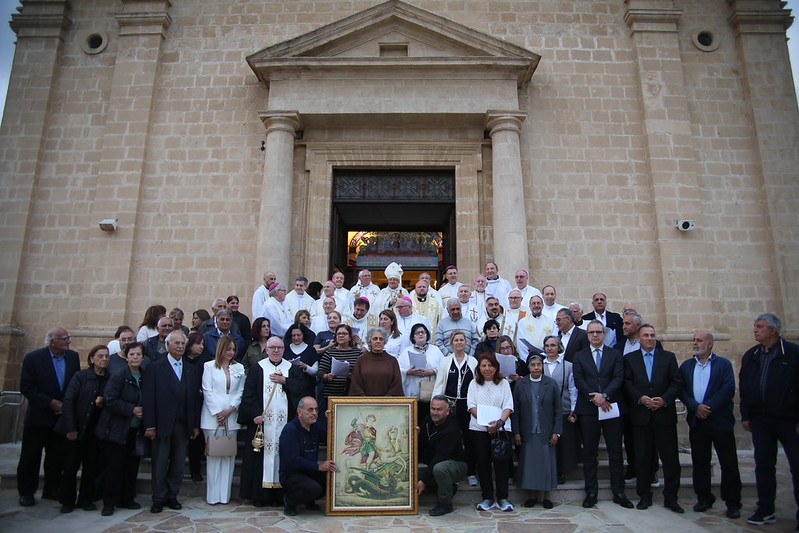
Bishops from the European Union, together with members of the Maronite Christian community of the village of Kormakitis, following the Holy Mass celebrated on the feast of Saint George. (Photo: Ada Lushi/COMECE)
Declaration ‘An urgent plea to seek peace and pursue it’ issued by the COMECE Assembly gathered in Nicosia, Cyprus. (Photo: COMECE)
Declaration: An urgent plea to seek peace and pursue it
The Bishops of the European Union were cordially hosted in Nicosia by the Maronite Archeparchy of Cyprus and its Archbishop, Selim Jean Sfeir. Being in Cyprus offered them a valuable opportunity to gain a deeper understanding of the complex challenges facing the Eastern Mediterranean, a crossroads between Africa, Europe and Asia located only a few kilometres from areas marked by armed conflict.
It is in this spirit that the bishops of the European Union issued the declaration ‘An urgent plea to seek peace and pursue it’, expressing their closeness to the victims of conflicts and renewing their support for all efforts aimed at building a just and lasting peace in the many places where wars and conflicts are currently causing suffering and loss of life.
In particular, in the declaration the bishops voice their deep sorrow for the victims, strongly recalling the urgency of laying down arms and pursuing authentic and lasting paths of dialogue. They reaffirm their full support and solidarity to Pope Leo XIV and his tireless appeals for peace. They also underline the role of the European Union as an actor called to promote stability, justice and reconciliation, in full respect of international law.
The bishops also renew their commitment to be artisans of peace, encouraging all actors not to give in to despair but to persevere in the search for a future grounded in hope and peaceful coexistence.
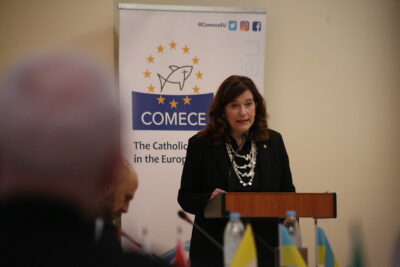
Dr Vasiliki Kassianidou, Cypriot Deputy Minister of Culture at the 2026 COMECE Spring Assembly in Nicosia, Cyprus. (Photo: Ada Lushi/COMECE)
The Cypriot EU Presidency
The Spring Assembly of COMECE took place in Nicosia in the context of the Cypriot Presidency of the Council of the European Union, which began in January 2026. In line with Article 17 of the Treaty on the Functioning of the European Union (TFEU), COMECE engages with each rotating EU Presidency, at different levels, offering its expertise and contributing to the policy priorities and initiatives of the Presidency.
On this occasion, the bishops of the EU had the opportunity to engage in dialogue with Dr Vasiliki Kassianidou, Cypriot Deputy Minister of Culture. The constructive exchange with the Deputy Minister focused on the key challenges facing Cyprus, particularly the continued division of the island, as well as the access to Christian places of worship, education and culture and the protection and preservation of cultural heritage.
The meeting also provided an opportunity to present to the Cypriot EU Presidency a document prepared by the COMECE Secretariat outlining policy recommendations for the Presidency’s semester. The speech of the Deputy Minister is available here. The COMECE contribution to the EU Presidency is available here.
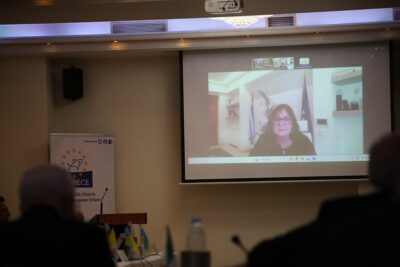
European Commissioner for the Mediterranean, Dubravka Šuica, intervening in video conference to the 2026 Spring Plenary Assembly of COMECE. (Photo: Ada Lushi/COMECE)
The Mediterranean as a space for encounter and dialogue
The decision to hold the Assembly in Cyprus also reflects the need felt by COMECE to underline the strategic importance of the Mediterranean region for the Union. The bishops recalled that the Mediterranean is one of the defining dimensions of Europe’s identity, emphasising that it should receive increasing attention from the EU and be shaped not by mistrust and confrontation, but by policies that promote encounter, dialogue, reconciliation, development and peace.
These themes were discussed with the European Commissioner for the Mediterranean, Dubravka Šuica. The Commissioner outlined the elements of greatest relevance for the Church within the recent EU Pact for the Mediterranean, whose first action plan was presented earlier this month and includes 21 initiatives focused on youth, investment and migration management.
Commissioner Šuica also expressed appreciation for recent initiatives concerning the Mediterranean undertaken by the Italian and French Bishops’ Conferences, noting that they support a vision of the Mediterranean as a place of encounter.
The Commissioner also devoted particular attention to the demographic question, especially the phenomenon of demographic winter affecting many EU Member States. This is an issue of strong concern for COMECE and remains one of the key areas in which it carries out its advocacy work with the EU institutions.
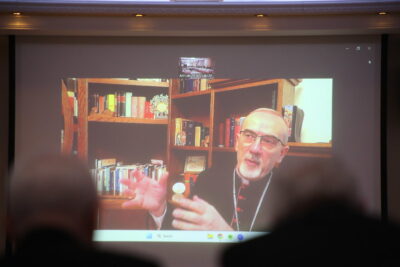
H.Em. Cardinal Pierbattista Pizzaballa, Latin Patriarch of Jerusalem, joining the Spring Plenary Assembly in video conference. (Photo: Ada Lushi/COMECE)
Christians in the Middle Eastern region
The bishops of the European Union devoted significant attention to the ongoing deterioration of the international and multilateral context, with particular regard to the wars that in recent times have affected the Holy Land, the Middle East, Eastern Europe and Africa.
Joining via video conference from Jerusalem, H.Em. Cardinal Pierbattista Pizzaballa, Latin Patriarch of Jerusalem, shared his witness of the life of Christians in the Holy Land, highlighting in particular their difficulties and resilience in the aftermath of 7 October 2023.
He described the daily challenges and violence experienced by local communities as a result of a multifaceted conflict involving numerous internal and international actors. In this context, Cardinal Pizzaballa encouraged the European bishops to promote interreligious dialogue in Europe, expressing the conviction that such efforts can have a positive impact also in the Holy Land and across the Middle East.
In this context, the role of the European Union as an actor for peace was further explored by the bishops in dialogue with Dr Christian Gsodam, Advisor for Strategic Communication and Foresight at the European External Action Service (EEAS). He framed the weakening of multilateralism within a broader reconfiguration of global balances and outlined both the great strengths but also the limitations of the EU’s role in several ongoing international crises, recalling the Union’s founding values and the need for all to be more engaged, including the Church as a relevant international actor and an important voice in the actual context.
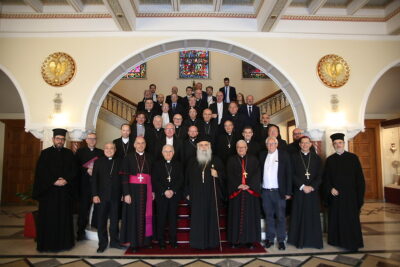
The bishops of the European Union received by His Beatitude Georgios III, Archbishop of Nova Justiniana and All Cyprus. (Photo: Ada Lushi/COMECE)
The Cypriot question
The stay in Nicosia offered an important opportunity for the COMECE bishops to gain a deeper understanding of the situation in Cyprus. Following the Turkish occupation of the northern part of the island in 1974, Cyprus remains divided by a physical barrier, with significant political, social, cultural and religious consequences.
The Cypriot question is currently characterised by a status quo which, while fortunately not marked by violence, risks becoming entrenched and therefore neglected by the EU and the international community. In this regard, COMECE stresses that the issue should be placed high on the political agenda of the European Union, as the Union’s credibility as a promoter of dialogue and peace also depends on its ability to contribute to the resolution of such local conflicts affecting its territory.
The bishops were received by His Beatitude Georgios III, Archbishop of Nova Justiniana and All Cyprus. The meeting provided a valuable opportunity for ecumenical dialogue among Greek Orthodox, Maronite and Latin Catholic communities.
In-depth discussions were held on the division of the island and the challenges faced by Christian communities living in the northern part. In this sense, particularly meaningful were the visits to the Maronite Christian villages of Karpasha and Kormakitis. There, the bishops were able to witness the struggles faced by these small communities, including the occupation of homes, the climate of suspicion and especially the restrictions on access to and use of certain churches.
Through their presence in these villages, the EU bishops wished to provide a concrete sign of solidarity with the local Christian communities. Under the inpulse of such experience, the bishops of the EU will advocate, in dialogue with the European institutions, for the rights of these Christian communities in the island and the preservation of their properties, heritage and presence.
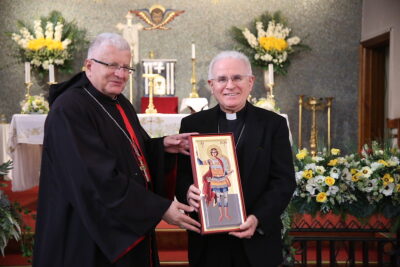
COMECE President Mgr Mariano Crociata (right) Mgr Selim Jean Sfeir, Archbishop of the Maronite Archeparchy of Cyprus. (Photo: Ada Lushi/COMECE)
Moments of prayer
The working sessions of the Assembly were complemented by moments of prayer. On Wednesday 22 April, the bishops concelebrated a Mass for Europe at the Cathedral of the Holy Cross (Latin Catholic Church), presided by H.E. Mgr Bruno Varriano OFM, Patriarchal Vicar for Cyprus of the Latin Patriarchate of Jerusalem.
On Thursday 23 April, the bishops celebrated a Mass in Maronite rite at St George’s church in Kormakitis, where they were welcomed by a large number of Maronite Christians from the area, gathered to celebratetogether the feast of the patron saint. The homily was offered by Archbishop Selim Jean Sfeir and is available here.
Next steps
The Autumn Plenary Assembly of COMECE will take place in Brussels, Belgium, on 14-16 October 2026.
Media & Download
Declaration ‘An urgent plea to seek peace and pursue it’ [EN – IT – DE – ES – NL – FR – SK – PT]
Report of the COMECE President Mgr Mariano Crociata [IT]
Welcoming speech of Mgr Sfeir [EN – IT]
Speech of Cyprus’ Deputy Minister of Culture Vasiliki Kassianidou [EN]
Homily offered by Archbishop Selim Sfeir for the Feast of St Georges celebrated in Kormakitis, Cyprus [EN, GR, IT, AR, FR]
Photo Gallery of the Assembly (by Ada Lushi/COMECE)