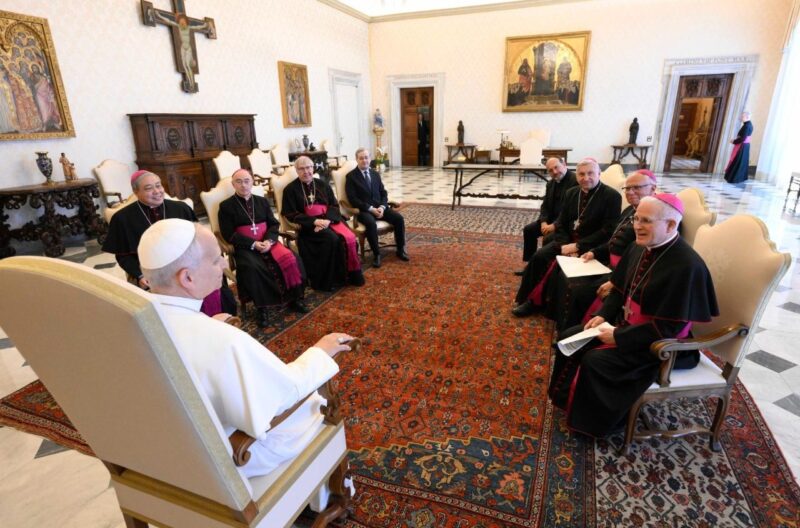
Pope Leo XIV received the Presidency of the Commission of the Bishops’ Conferences of the European Union (COMECE) in private audience on Thursday, 21 May 2026. The meeting was marked by a profound exchange on the current situation and role of the European Union, regarded as a key actor in promoting dialogue and peace and as a force supporting multilateralism. Photo Gallery
COMECE Presidency during a private audience with Pope Leo XIV. May 2026. (Photo: Vatican Media)
For the Presidency of COMECE, this was the second audience since Pope Leo XIV was elected to the See of Peter. The meeting was cordial and focused on issues of major concern for the Church in the EU, reflecting the Holy Father’s close attention to the European project, seen as an international pillar and an example of dialogue and peace, capable of fostering cooperation among nations rather than a logic of confrontation.
At the conclusion of the audience, H.E. Mgr Mariano Crociata, President of COMECE, explained that “the audience was particularly cordial, direct and open regarding the issues discussed. The underlying tone was one of strong harmony between our work and what the Pope teaches and witnesses through his magisterium, his positions and his initiatives”.
The various themes discussed during the audience were presented by the members of the COMECE delegation during a press conference held in Rome shortly afterwards.
The bishops underlined the Holy Father’s close attention to EU affairs, particularly to the role and posture of the European Union as an international actor committed to the promotion of dialogue and peace. The hope expressed during the audience was that the European Union would continue fostering bridge-building, dialogue and multilateralism at a time when these principles have become increasingly fragile in the international context.
Reflecting on the relationship between the Church and the EU institutions, the Holy Father also emphasised the importance of contributing to political life without allowing the Church to be labelled or drawn into partisan dynamics and instrumentalization.
In this context, the COMECE bishops and the Holy Father also addressed the growing political and social polarisation affecting many European societies, as well as the rise of populism, seen as a consequence of declining social cohesion, a growing distance between political institutions and citizens’ concerns, and the emergence of new social and geopolitical challenges.
“The European Union,” Mgr Crociata stated, “was born as a project of peace, and peace lies at its roots and in its identity. It is therefore called to foster dialogue among countries and international institutions, while also promoting multilateralism, as the Pope explicitly recalled.”
At the same time, the President of COMECE noted that the European Union’s mission, in a world marked by growing polarisation, “is weakened by the lack of internal unity, also as a result of populism.”
The bishops also updated the Holy Father on the recent appointment of the new EU Special Envoy on Freedom of Religion or Belief outside the European Union, as well as on recent developments concerning the possible establishment of a Coordinator on combating anti-Christian hatred in the European Union. This latter proposal, promoted by COMECE over the past two years, was recently included in a resolution adopted by the European Parliament.
Finally, the delegation conveyed to the Holy Father the strong desire present in Brussels and Strasbourg for a future visit of His Holiness to the institutions of the European Union.
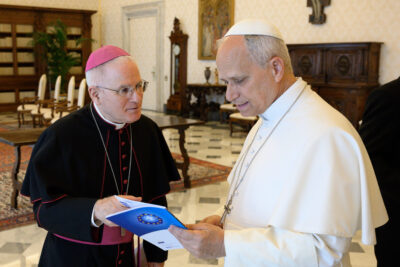
Mgr Mariano Crociata offers the 2025 COMECE Annual Report to Pope Leo XIV. (Photo: Vatican Media)
Rethinking Europe in 2027
The COMECE delegation also presented to the Holy Father the proposal to organise a new edition of “Rethinking Europe” in the autumn of 2027.
The event would take place exactly ten years after the first edition, which gathered around 300 participants at the Vatican, including representatives of the European Union and its Member States, academics and representatives of Churches. The event aimed to reflect on the challenges facing Europe and to explore ways to strengthen and renew the European project.
During the press conference, the President of COMECE explained that this new major event “is intended to be a particularly important moment of reflection and dialogue on the challenges facing Europe and the world as a whole”.
Further details regarding the dates and programme of the event will be announced in the coming months.
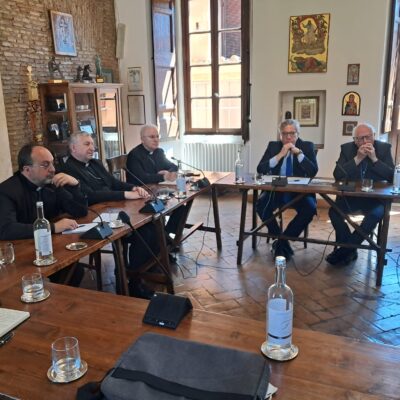
COMECE Presidency meeting with representatives of Community of Saint Egidio. Rome, May 2026 (Photo: COMECE)
Institutional meetings in Rome
The COMECE delegation also held a number of other institutional meetings, particularly with representatives of the Holy See, focusing on several issues of major concern for the Church that are currently high on the European political agenda.
The themes of peace and the role of the European Union in promoting dialogue and multilateralism were at the centre of in-depth exchanges with His Eminence Cardinal Pietro Parolin, Secretary of State of His Holiness, and with Archbishop Paul Richard Gallagher, Secretary for Relations with States and International Organisations.
The delegation was also received by the Dicastery for Promoting Integral Human Development where, together with H.E. Card. Fabio Baggio, discussions focused on European Union policies concerning migrants and refugees, as well as the care of our Common Home. Particular attention was devoted to several aspects of the EU Pact on Migration and Asylum, which is being implemented this year, as well as to what appears to be declining attention within the European institutions towards environmental protection policies and a just energy transition.
Migration-related issues were also discussed with representatives of the Community of Sant’Egidio, with whom the delegation reflected in particular on humanitarian corridors, as well as on questions related to promoting peace on the continent and in its neighbourhood.
The Presidency of COMECE also met with H.Em. Card. José Tolentino de Mendonça, Prefect of the Dicastery for Culture and Education. Discussions focused on artificial intelligence, especially the ethical and social challenges posed by this new technology, as well as the opportunities it may offer. The discussion also touched upon support for education in Africa.
The participants also reflected on the forthcoming Encyclical Letter Magnifica humanitas, the first of Pope Leo XIV, expected to be presented by the Pontiff on Monday, 25 May 2026. Attention was also devoted to the importance of culture and education as instruments for the promotion of dialogue and peace.
The bishops of COMECE also met with H.Em. Card. Matteo Zuppi, President of the Italian Bishops’ Conference (CEI).
The COMECE delegation was composed of:
- H.E. Mgr Mariano Crociata, President
- H.E. Mgr Bernardito Cleopas Auza, Apostolic Nuncio to the European Union
- H.E. Mgr Antoine Hérouard, First Vice-President
- H.E. Mgr Rimantas Norvila, Vice-President
- H.E. Mgr Nuno Brás da Silva Martins, Vice-President
- H.E. Mgr Czesław Kozon, Vice-President
- Fr Manuel Barrios Prieto, General Secretary of COMECE
- Mr Alessandro Calcagno, Assistant to the General Secretary of COMECE.
A photo gallery collecting photos from the audience and the other institutional meetings, can be explored here.