
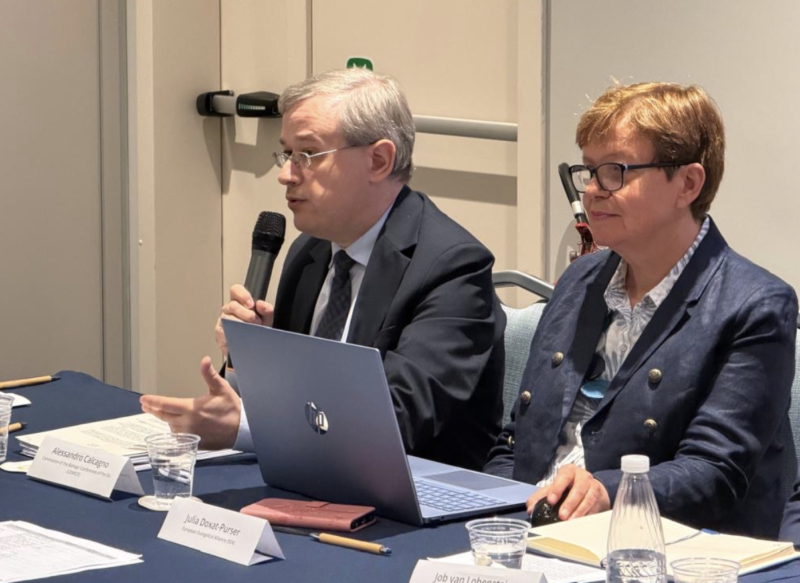
 The Commission of the Bishops’ Conferences of the European Union (COMECE) participated in the regional workshop on “Responding to anti-Christian hate crimes and addressing the security needs of Christian communities”, organised in Rome, Italy, by the OSCE Office for Democratic Institutions and Human Rights (ODIHR) on 26-27 May 2026. The event brought together experts from multiple sectors, including actors committed to effective data collection in this field. Read COMECE contribution | Photo gallery
Adviser Alessandro Calcagno intervened as a speaker on behalf of COMECE during the session devoted to “Community perspectives on current challenges and opportunities pertaining to addressing anti-Christian hate crime and the security needs of Christian communities in Western Europe”. Read his full intervention here.
During the event, COMECE expressed its appreciation for the work being carried out at OSCE level to combat anti-Christian hatred and for the recent Practical Guide Understanding Anti-Christian Hate Crimes and Addressing the Security Needs of Christian Communities, describing it as an example of institutional best practice that should encourage an equally proactive approach at European Union level.
Calcagno underlined that this is a fundamental rights issue, welcoming efforts to move beyond approaches based on a ‘minorities versus majorities’ dynamic. For COMECE, “it is essential to provide tools for protection against discrimination, hate speech and hate crimes for the faithful and the places of worship of religious denominations, regardless of whether they belong to a ‘majority’ or a ‘minority’, while acknowledging the specific challenges and situations of different religious communities”.
The COMECE call for the appointment of an EU Coordinator to combat anti-Christian hatred, recently reflected in a Resolution of the European Parliament, was recalled, together with an encouragement to national authorities to establish similar positions and provide them with sufficient resources.
The close link between policies aimed at protecting places of worship and the exercise of freedom of religion was also highlighted. Measures and initiatives to protect places of worship should not be limited to acts of terrorism, but should also cover other forms of attacks, including vandalism, profanation, disruption of religious services, defacement and arson, while at the same time avoiding the ‘securitisation of worship’.
Calcagno also called for the inclusion of local Churches in relevant national processes as primary stakeholders, ensuring their full involvement in the development and implementation of comprehensive national strategies and action plans to address the issue. Innovative forms of public funding were also identified as a relevant element.
Adviser Calcagno further highlighted that combating religious illiteracy in society – including at times within public authorities – should be a priority, alongside measures aimed at strengthening deterrence and encouraging reporting. He also stressed the contribution that robust protection of freedom of religion can make to creating a dissuasive environment for potential offenders.
COMECE looks forward to the recommendations that will follow the meeting and stands ready to continue its cooperation with the OSCE on this matter. The issue will also be addressed at the next meeting of the COMECE Legal Affairs Commission in September.