
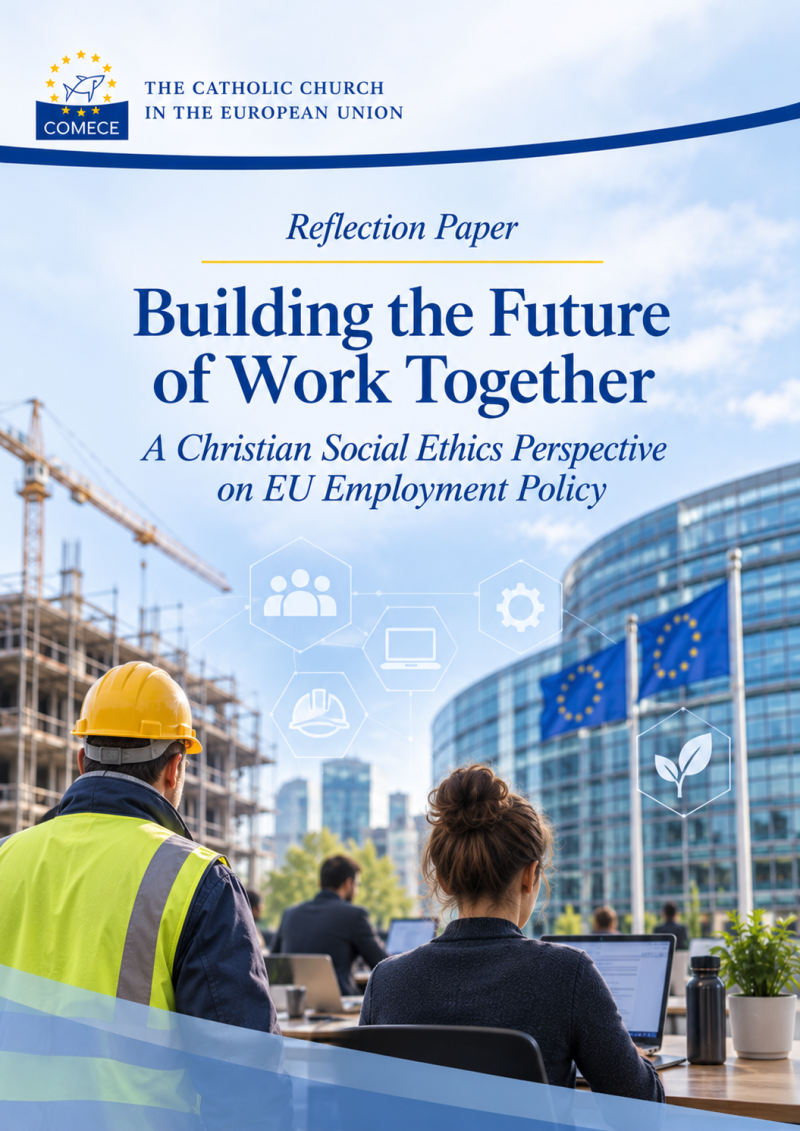
The Commission of the Bishops’ Conferences of the European Union (COMECE) published on Monday, 9 November 2026 the Reflection Paper Building the Future of Work Together: A Christian Social Ethics Perspective on EU Employment Policy. The document examines the profound transformations reshaping employment and labour across Europe, including technological innovation, artificial intelligence (AI), demographic change and the ecological transition. Download the Reflection Paper

The COMECE Social Affairs Commission. Brussels, March 2026. (Photo: COMECE)
Within the scope of the EU’s competences and drawing on the principles of Catholic Social Teaching, it calls for a European labour policy that places the dignity of the human person, solidarity, subsidiarity and the common good at its heart.
The reflection paper highlights that work is not merely an economic commodity or a source of income, but a fundamental dimension of human dignity, integral human development and social participation. According to COMECE, as Europe faces new challenges in its labour markets, economic and technological progress must remain at the service of people, families and communities, ensuring that no one is left behind.
The document sets out 16 policy recommendations for the European Union and its Member States, framed within four interconnected perspectives to guide reflection and inform policy action:
- Promoting human dignity and the common good through just labour: ensuring decent wages, fair working conditions, secure employment and greater recognition of essential workers, while promoting a socially and ecologically sustainable economy.
- Work, integral human development and flourishing families: recognising the value of care work and family responsibilities, promoting a better reconciliation of professional and personal life, and safeguarding adequate rest and the right to disconnect.
- Artificial intelligence and robotisation: ensuring that technological innovation enhances human capabilities rather than replaces human responsibility, while protecting workers against surveillance, discrimination and exclusion and promoting access to training and reskilling.
- Participation, subsidiarity and responsibility at work: strengthening social dialogue and workers’ involvement in decisions concerning economic and technological transformations, with a view to fostering autonomy, dignity and inclusion.
At a time when Europe is facing far-reaching economic, social and technological changes, the reflection paper emphasises the need for a shared responsibility among EU institutions, Member States, employers, trade unions and civil society to shape a future of work that is just, resilient and sustainable.
Image generated with AI.
By placing the human person at the centre of employment policy, the European Union can ensure that innovation and economic development contribute not only to productivity but also to social cohesion, the well-being of workers and their families and the common good. This requires recognising that the value of work extends beyond paid employment and creating conditions in which families can genuinely choose how to balance professional and caring responsibilities.
The Reflection paper Building the Future of Work Together: A Christian Social Ethics Perspective on EU Employment Policy was elaborated by the COMECE Social Affairs Commission, chaired by H.E. Mgr Joseph Galea-Curmi (Malta).
The reflection and drafting process also benefited from valuable contributions from experts in the fields addressed, including members of academia, young people, representatives of trade unions and Catholic organisations from all corners of the European Union. COMECE is grateful to all those who contributed to the development of this paper and enriched the process with their expertise and insights.
Download the Reflection paper [EN]
