
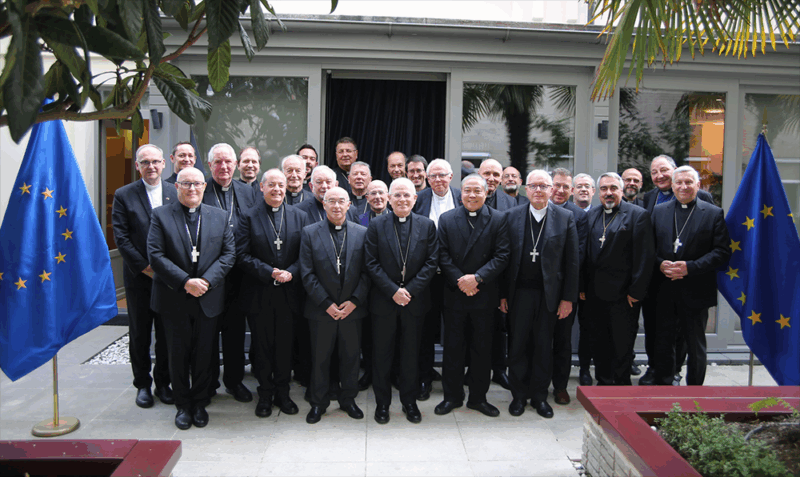
The bishops of the European Union call on the EU and its Member States to ensure that Artificial Intelligence (AI) remains firmly at the service of the human person, the common good and peace. The call comes in a declaration adopted at the conclusion of the autumn Plenary Assembly of COMECE, held in Brussels from 14 to 16 October under the theme “Magnifica humanitas: Europe, Human Dignity and the Common Good”. Declaration [EN – IT – DE – ES – FR – SK] | Video recordings [Part I – Part II – Part III] | Photo Gallery | Report of the President | Address of the Apostolic Nunciature | Telegram to Pope Leo
2026 Autumn Assembly of COMECE, Brussels. (Photo: Ada Lushi/COMECE)
The Declaration
In their statement, entitled “Europe’s responsibility in the time of Artificial Intelligence: A call to safeguard the Human Person”, the bishops acknowledge the significant opportunities offered by AI for integral human development and the common good, while stressing that its rapid development also raises profound anthropological, ethical, social and legal questions.
“Humanity stands at a decisive moment in which technological progress must be guided by a renewed commitment to the dignity of every person, justice and fraternity”, the bishops state.
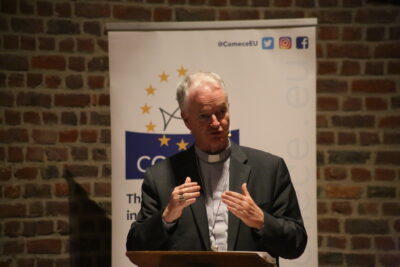
H.E. Mgr Paul Tighe, Secretary of the Dicastery for Culture and Education of the Holy See. (Photo: Ada Lushi/COMECE)
The bishops recognise the efforts already undertaken to regulate AI and encourage the European Union to assume leadership in this field in accordance with its founding values and mission.
They call on Europe to act “with urgency, ambition and responsibility” to strengthen its digital capacities and contribute to the research, design and development of AI technologies, promoting a genuinely human-centred vision.
According to the bishops, the EU should also play a positive and leading role in international cooperation and AI governance, ensuring respect for human rights, preventing harmful uses of technology and promoting equitable access to its benefits. This responsibility must be shared by European institutions, businesses, intermediary organisations, educational communities and citizens.
The statement sets out eight principles which the bishops strongly encourage the European Union and its Member States to implement and promote in international fora:
- Human dignity and human agency must remain paramount.
- The common good, solidarity, subsidiarity, care for creation and justice must guide technological innovation.
- Responsibility, transparency and accountability must accompany AI.
- AI must not become a source of discrimination, exclusion or manipulation.
- AI must not diminish or displace the uniqueness of the human person, and human beings must not be reduced to data or commodities.
- The digital and technological commons require responsible governance.
- Democracy and the rule of law must be protected.
- AI must contribute to peace and human fraternity.
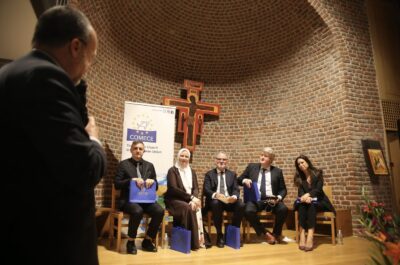
Panel debate during the presentation of ‘Magnifica humanitas’ in Brussels. (Photo: Ada Lushi/COMECE)
The bishops conclude by stressing that the future of AI cannot be determined solely by technological capabilities or economic interests.
“Artificial Intelligence must remain a means at the service of the human person, the common good and peace. Its future must be shaped not only by what technology can do, but by what human dignity, responsibility, solidarity and fraternity require.”
Presentation of the Magnifica humanitas
Pope Leo XIV’s first Encyclical Letter, Magnifica humanitas, was presented in Brussels on 14 October during a high-level public event organised by COMECE at the Chapel for Europe, in the context of COMECE’s 2026 autumn Assembly.
The event brought together representatives of the Holy See and the European institutions, policymakers, experts in Artificial Intelligence and journalists.
Published in May 2026, Magnifica humanitas addresses one of the defining challenges of our time: how to ensure that the rapid development of Artificial Intelligence remains at the service of the human person. The Encyclical has also attracted significant attention within the institutions of the European Union.
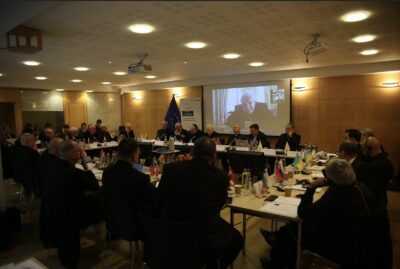
Bishops exchanging with H.Em. Card Jean-Marc Noël Aveline, President of the French Bishops’ Conference. (Photo: Ada Lushi/COMECE)
The Brussels presentation provided an opportunity to consider the relevance of these reflections in the European context, as the European Union seeks to develop its technological capacities while ensuring that AI respects fundamental rights and serves society as a whole.
The event featured the participation of H.E. Mgr Paul Tighe, Secretary of the Dicastery for Culture and Education of the Holy See, who delivered a keynote speech reflecting on the implications of Artificial Intelligence for the Church, culture and human dignity.
A panel discussion followed, featuring contributions from MEP Antonella Sberna, Vice-President of the European Parliament in charge of the implementation of Article 17 TFEU; MEP Michael McNamara, Co-Chair of the European Parliament’s AI Working Group; Ms Anna A. MacMillan, CSO & Board Member of the Domus Communis Foundation; and Mr Enrico Rubboli, Founder & CEO of Mintlayer. The discussion was moderated by Mr Leonardo Cervera-Navas, Secretary-General of the European Data Protection Supervisor.
The event also included a Q&A session, allowing the many participants attending in person and online to put their questions to the panellists. A video recording of the event is available here.
The works of the Assembly
Alongside the public event presenting Pope Leo XIV’s Encyclical Letter Magnifica humanitas to a Brussels audience, the COMECE Assembly featured a number of moments of dialogue on topics relevant to the Church in Europe.
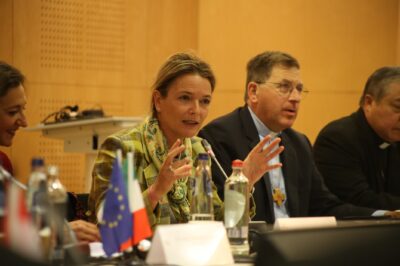
Maria Torrego (Fundación Redmadre) and Ségolène du Closel (Oneofuseu) during the autumn Assembly. (Photo: Ada Lushi/COMECE)
In particular, the bishops exchanged views with H.Em. Card Jean-Marc Noël Aveline, President of the French Bishops’ Conference, on the mission of the Church in Europe in light of Pope Leo XIV’s Apostolic Journey to France, with a particular focus on the promotion of peace in Europe and beyond.
The bishops also had the opportunity to hear from Maria Torrego, President of Fundación Redmadre, and Ségolène du Closel, Executive Director of Oneofuseu, who shared the experience and good practices of their respective organisations in conveying to the EU institutions the needs and concerns of women and men facing challenges related to family, pregnancy and life.
Another important exchange was held with Jean-Baptiste de Franssu, President of the Collegial Board of the Collège des Bernardins and former President of the Institute for the Works of Religion (IOR). The discussion focused on ethical and sustainable investment, combining financial returns with a positive impact on society, the environment and governance, particularly in the current geopolitical context.
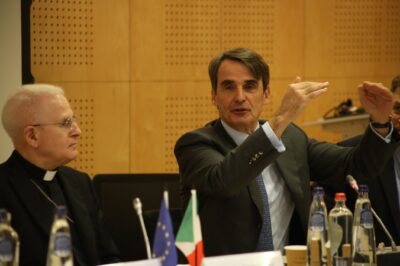
Jean-Baptiste de Franssu (Collège des Bernardins). (Photo: Ada Lushi/COMECE)
EU bishops send message of prayer and support to Pope Leo XIV
During their autumn Assembly in Brussels, the bishops representing the Bishops’ Conferences of the European Union sent a message of prayer and support to Pope Leo XIV, wishing him a speedy recovery following his recent surgery.
In their message, the bishops wrote:
“Most Holy Father, Pope Leo XIV, as bishops of the Commission of the Bishops’ Conferences of the European Union (COMECE), gathered in Brussels for our autumn Assembly, we wish to convey to you our warmest wishes for a speedy recovery following your surgery. We have followed the news of these past days with deep concern and prayer. We will continue to accompany you with our prayers to the Lord of Life, confident that you will soon resume, with renewed energy and enthusiasm, your precious mission at the helm of the Church.”
The telegram was conveyed to the Holy Father through H.E. Mgr Bernardito Cleopas Auza, Apostolic Nuncio to the European Union, who also took part in the COMECE Assembly.
EU bishops celebrate Mass for Europe in Brussels
During the Assembly, various moments of prayer accompanied the bishops throughout their work. Among these was the Mass for Europe, celebrated on Thursday, 15 October, at the Église Notre-Dame des Victoires au Sablon in Brussels.
The Mass was presided over by H.E. Mgr Mariano Crociata, President of COMECE, and concelebrated by the bishops taking part in the Assembly. The celebration featured musical accompaniment by the Polish choir Domino Cantus.
The next Assembly
The next Plenary Assembly of COMECE will take place in Brussels on 21-24 April 2027.
Media
Declaration [EN – IT – DE – ES – FR – SK]
Video recordings [Part I – Part II – Part III]
Report of the President
Address of the Apostolic Nunciature
Telegram to Pope Leo
Photo Gallery
 Statement 16102026 - Europe's responsibility in the time of Artificial Intelligence [EN]
- Statement 16102026 - Europe's responsibility in the time of Artificial Intelligence [IT]
- Statement 16102026 - Europe's responsibility in the time of Artificial Intelligence [DE]
- Statement 16102026 - Europe's responsibility in the time of Artificial Intelligence [ES]
- Statement 16102026 - Europe's responsibility in the time of Artificial Intelligence [FR]
- Statement 16102026 - Europe's responsibility in the time of Artificial Intelligence [SK]
- Report 14102026 - Report of the President of COMECE to the 2026 Autumn Assembly [IT]
- Speech 14102026 - Apostolic Nuncio to the EU to the COMECE Assembly [EN]