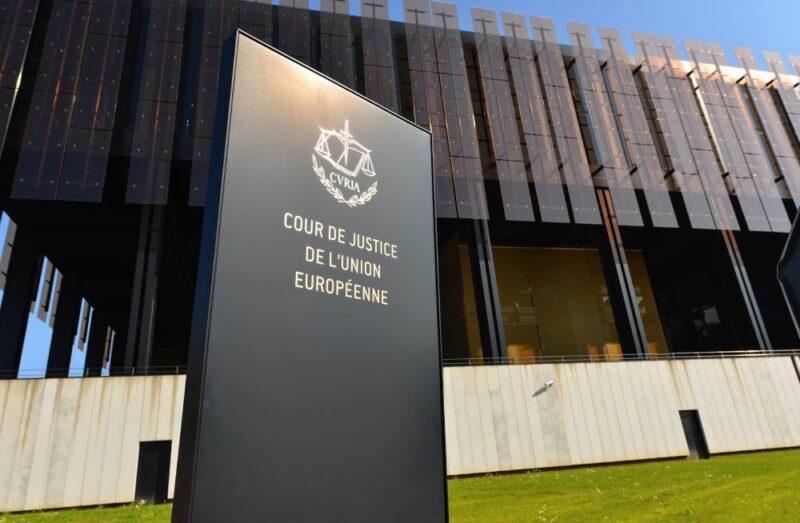

The European Court of Justice on Kirchberg Plateau, Luxembourg. (Photo: Shutterstock/COMECE)
The Presidency of the Commission of the Bishops’ Conferences of the European Union (COMECE) has examined the recent judgment of the Court of Justice of the European Union in the case Wojewoda Mazowiecki (C-713/23). In a statement released today, Tuesday, 9 December 2025, the Presidency of COMECE recalls the Church’s “anthropological view, based on natural law, of marriage as a union between a man and a woman” and highlights that the Court decision appears to push jurisprudence beyond EU competences. Read the Statement: EN | IT | DE | FR | ES | SK | HU
While fully respecting the role of the EU judiciary, the Presidency of COMECE, led by H.E. Mgr. Mariano Crociata, notes with concern that the ruling may impact on questions lying at the core of national competences. COMECE has long stressed the need for a prudent and cautious approach to family law cases that have cross-border implications and to avoid undue influences on the national legal systems of the EU Member States. The ruling provided an opportunity to more generally assess the current state and orientation of EU jurisprudence on the matter.
The ruling obliges a Member State to recognise a marriage between two EU citizens of the same sex lawfully concluded in another Member State where they have exercised their freedom to move and reside. Although the Court acknowledges that rules on marriage “come within the competence of the Member States”, COMECE highlights that the Court decision appears to push jurisprudence beyond EU competences and recalls that Article 9 of the Charter of Fundamental Rights of the EU states that “the right to marry and the right to found a family shall be guaranteed in accordance with the national laws governing the exercise of these rights”.
COMECE also regrets the limited role attributed to national identities (Article 4.2 TEU), noting that for some Member States the definition of marriage forms part of their national identity. The ruling may foster pressure to amend national family law, creating a convergence of matrimonial-law effects despite the EU having no mandate to harmonise family law and may also increase legal uncertainty.
COMECE notes with concern that the approach adopted on the matter may lead to negative developments in other sensitive areas, such as surrogacy.
Bearing in mind the current challenging situation in the EU and the polarisation present in our societies, the bishops warn that such judgments may fuel anti-European sentiments in Member States and be easily instrumentalised for that purpose.