
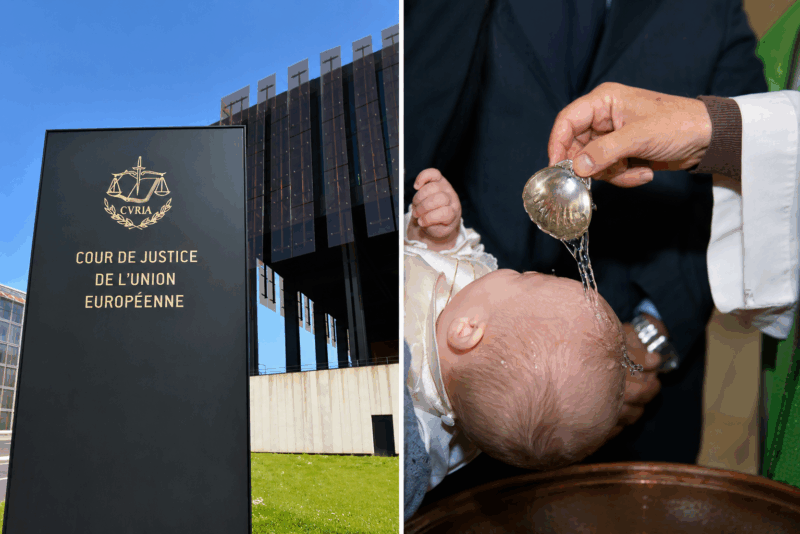
On Monday, 5 October 2026, the Secretariat of the Commission of the Bishops’ Conferences of the European Union (COMECE) expressed concern about the initial indications emerging from the Court of Justice of the European Union case C-12/25, Bisdom Gent, concerning the erasure of personal data from baptismal registers, following the Opinion delivered on 1 October.
The non-binding Opinion of the EU Court’s Advocate General considers the assessments required by the case as “complex” and, in a number of regards, it leaves room for the role of national courts. The Opinion also refers to the relevance of Church autonomy and of its freedom of religion, as well as to the importance for the Church of the “correct administration of the sacraments”.
However, without prejudice to further assessments, several elements expressed in the Opinion raise concerns and questions.
The Opinion essentially rejects the solution of adding to the baptismal record a marginal annotation of the wishes of the relevant data subject. The Advocate General thus distances itself from the fact that – across diverse legal systems and State-Church relations models – consistent national jurisprudence in the EU Member States has accepted this practice as an entirely adequate legal solution in case of erasure requests concerning baptismal registers.
Erasing the name and surname of the baptised person from the record of a baptism entirely deprives the registration of the baptism, as such, of its meaning, value and purpose. This crucial aspect seems to have been neglected. According to COMECE, focus on the impact of erasure on the interests and rights of third parties is also lacking in the Opinion.
Furthermore, the considerations regarding the possible emotional distress that could result from retaining a person’s data in a baptismal register are also unconvincing.
COMECE is concerned that, if confirmed, the orientation provided by the Opinion may create significant legal uncertainty for ecclesiastical data controllers in every EU Member State. This is particularly serious because such uncertainty would strike at baptismal registers, which are a central pillar of the Church’s internal functioning and organisation, and are vital to enabling it to carry out its mission.
To avoid misconstructions, it is important to highlight that no general or automatic right to erase data from baptismal records is recognised in the Opinion.
In his recent address in Metz, Pope Leo XIV, quoting Article 17 of the Treaty on the Functioning of the EU (TFEU), recalled that the principle of secularity governing the life of States also presupposes respect by national and European authorities for the autonomy of Churches and the promotion of their freedom of organisation, expression and worship.
COMECE looks forward to the judgement the EU Court, which is expected in the incoming months, and hopes that it will establish a more favourable line with regard to the protection of baptismal registers from erasure.
The COMECE Legal Affairs Commission is studying the Opinion in-depth in view of a possible position paper on the matter.