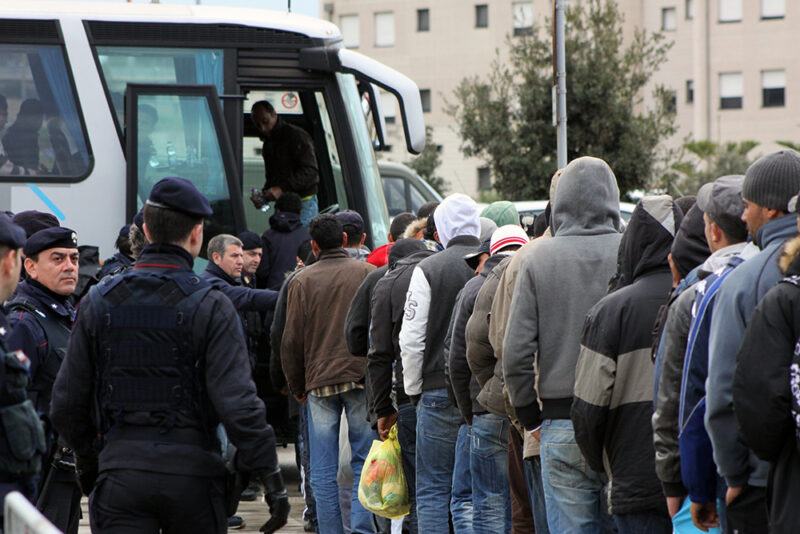
African and Middle Eastern migrants in Puglia, Italy. (Photo: Massimo Todaro/Shutterstock)
The Commission of the Bishops’ Conferences of the European Union (COMECE) publishes a statement by its President, H.E. Mgr. Mariano Crociata, in response to the vote held today, Wednesday 17 June 2026, in the European Parliament on the new Return Regulation, which complements the recently implemented Pact on Migration and Asylum. Read & Download the Statement
In his statement, bishop Crociata acknowledges the legitimate responsibility of public authorities to manage migration, ensure the integrity of borders and combat human trafficking. At the same time, he expresses serious concern regarding elements of the new framework that may undermine the effective protection of fundamental rights and the dignity of vulnerable persons.
“Migration is not merely a matter of procedures, statistics or border management. It concerns human beings: women, men and children, each possessing an inviolable dignity that must remain at the centre of every policy decision”, the statement reads.
The COMECE President highlights in particular concerns related to the expansion of detention, limitations on effective remedies and appeals, and the growing externalisation of responsibilities to third countries, noting that these developments raise “serious ethical and humanitarian questions”.
The statement also places COMECE’s position within the broader framework of the Catholic Church’s teaching and in continuity with the appeals recently made by His Holiness Pope Leo XIV during his visit to the Canary Islands. Recalling the Holy Father’s call not to remain indifferent to those who perish at sea, fall victim to human trafficking or are forced to flee war, violence, persecution, hunger and environmental degradation, Mgr Crociata underlines that migrants are not “a category or a statistic”, but persons who “could be part of our own family”.
Drawing on Pope Leo XIV’s message, the COMECE President stresses that Europe’s response to migration must remain firmly rooted in its foundational values. “The European Union was founded on the conviction that human dignity is inviolable and that solidarity among peoples is not an optional ideal but a fundamental responsibility”, he states, warning that Europe cannot remain accustomed to the Mediterranean and the Atlantic becoming “silent cemeteries” for people seeking safety and a future for their families.
The statement reiterates COMECE’s longstanding call for migration and asylum policies that fully respect human dignity, fundamental rights, the right to seek asylum, the protection of family unity and special care for the most vulnerable. It also emphasises that “security and solidarity are not opposing principles; they must advance together”.
Echoing Pope Leo XIV’s appeal to the international community, Mgr Crociata further underlines the shared responsibility of countries of origin, transit and destination in addressing the root causes of forced migration and protecting people on the move. He recalls that every person has not only the right to seek protection when their life is threatened, but also the right not to be compelled to leave their homeland because of war, persecution, poverty, corruption or environmental collapse.
Concluding his reflection, the COMECE President notes that the debate extends beyond migration policy alone. “Today’s vote concerns more than migration policy. It raises a broader question about the kind of Europe we wish to build”, he states, calling on Europe “not to retreat from its founding values, but to reaffirm them with courage, wisdom and humanity”.