
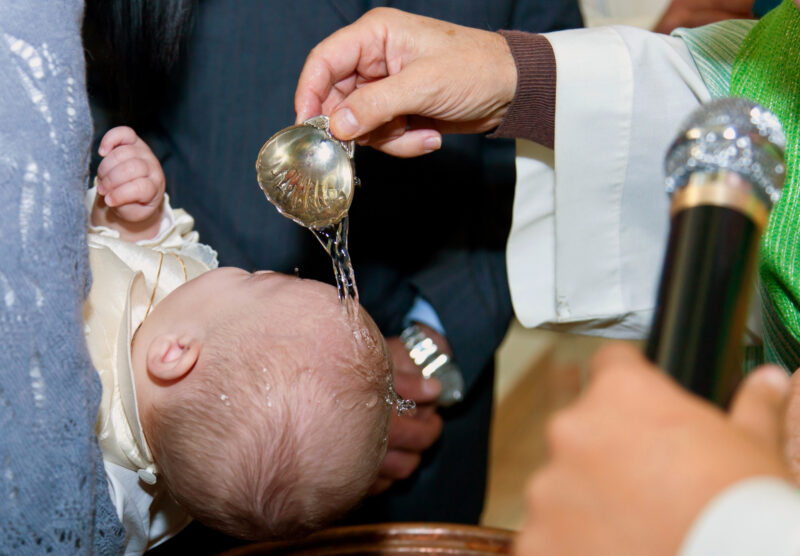
Priest pouring water on a baby’s head during a baptism ceremony with family and friends present. (Photo: Shutterstock)
The Commission of the Bishops’ Conferences of the European Union (COMECE) publishes on Friday, 4 September 2026 a position paper on key legal aspects in view of case C-12/25 Bisdom Gent, currently before the Court of Justice of the European Union. The document contributes to the public debate on the erasure of entries from baptismal registers in relation to EU data protection legislation. Download the Position Paper
The document was elaborated in light of the reflections carried out within the COMECE Legal Affairs Commission and in response to requests from the EU Bishops’ Conferences. The position paper seeks to outline both the possible implications of the case C-12/25, Bisdom Gent and the relevance of legal arguments that may play a role in view of its outcome.
The text prepared by the Secretariat of COMECE addresses various elements that are of high importance for the case in question, among them:
- The practice of annotating the wishes of the data subject in the margin of baptismal registers: such annotations cannot lead to concluding that baptismal registers are ‘lists of members’ in the Church. These annotations address needs and interests that do not derive from Canon Law, and, as recently underlined in academia, merely constitute a spontaneous implementation by the Church of indications deriving from civil laws.
- Nature and character of baptismal registers: this section of the paper showcases substantial jurisprudence from the Member States constantly protective of baptismal registers from erasure. COMECE points to the impact erasure would have on future actions within the Church, preventing verifications that are vital for carrying out its mission. Furthermore, it is underlined that the nature itself of baptismal registers cannot be adapted to reflect the views of a baptised person who does not wish anymore to be identified as Catholic.
- Erasure from baptismal registers and its impact on third parties: erasure from baptismal registers would have a prejudicial effect on the interests and rights of the parents, the godparents, as well as of the minister of baptism. Equally relevant is the impact on cases concerning marriage, as erasure would make it impossible to trace crucial information in view of various actions. Analogies are also traced with state civil registries.
- Baptismal registers as source of evidence in civil proceedings: a number of examples are outlined from the national level, proving the relevance baptismal registers can have as evidence in legal cases ranging from succession to citizenship, from birth registration to access to pensions and property claims.
- The crucial role of freedom of religion: the institutional dimension of freedom of religion is particularly emphasised, including on the basis of recent academic contributions. Registration of baptisms also reflects a theological reality, not merely administrative matters. The full respect for the negative aspect of freedom of religion within the Church is also illustrated (e.g. no limitation on the freedom of baptised persons who wish to distance themselves from the Church, on freedom not to take part in religious practice etc.)
- Safeguarding Church-State relations in the Member States and Church autonomy: the role of Article 17, paragraph 1 of the Treaty on the Functioning of the EU (TFEU) is stressed, in connection with the need to avoid any undesired effect on peaceful relations between the State and the Church. The COMECE document restates that it would be problematic if the nature and character of baptismal registers were to be re-defined by a civil court as a ‘lists of members’.
- Right to object: the ‘compelling’ nature of the legitimate grounds the Church can rely on derives directly from the fundamental role and standing of baptism in Canon Law (i.e. gateway to the other sacraments, foundation for participation in Church life). Institutional freedom of religion should be given real and substantial weight in the balancing required by the GDPR. As for the impact on the interests or rights of the data subject, the paper underlines that this is significantly reduced by the safeguards adopted by the Church.
- Genealogical research: baptismal registers constitute a historical source of considerable value for the reconstruction of the ecclesial community, but also of social life of local communities and have high value, inter alia, for genealogical research.The COMECE position paper concludes by underlining that the case C-12/25 Bisdom Gent, currently at the EU Court, is not only about whether certain personal data should be retained by the Church. It also raises the deeper question to what extent EU data protection law may require a Church to change the way in which it gives visible and juridical expression to its faith.
The Opinion of the Advocate General in the proceedings is expected for 1 October 2026. The Secretariat of COMECE will continue to follow attentively the progress of the case in question, including within the context of the COMECE Legal Affairs Commission.