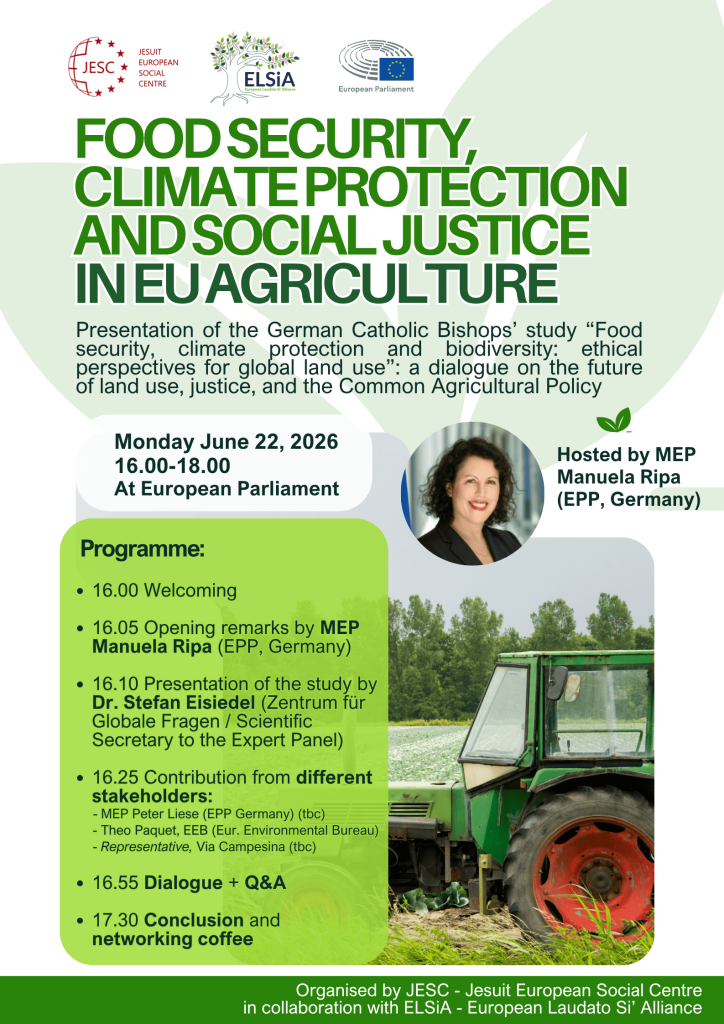
 The Commission of the Bishops’ Conferences of the European Union (COMECE) encourage you to participate in the ELSiA-JESC event “Food security, climate protection and social justice in EU agriculture” to take place at the European Parliament on Monday, 22 June 2026 at 16:00 (CEST). Registration: in-person (for people with an EP badge) | online
European agriculture is facing a defining structural transition. The sector must simultaneously deliver food security for European and global populations, drive climate mitigation and adaptation, restore biodiversity and ecosystems, and sustain viable rural livelihoods and landscapes across the continent. These objectives are deeply interconnected and, at times, in tension.
During the event, the landmark 2025 study commissioned by the German Bishops’ Conference, “Food Security, Climate Protection and Biodiversity: Ethical Perspectives for Global Land Use”, will be presented. This study argues that these challenges demand a systemic response: one that integrates ecological limits, social justice, and global responsibility rather than treating each issue in isolation.
Against the backdrop of ongoing post-2027 Common Agricultural Policy (CAP) reform debates, this event brings together ethical, political, economic, and practical perspectives to explore how the EU can build a fair, resilient, and sustainable food system.
The CAP reform process highlights the political difficulty of balancing environmental ambition, income stability for farmers, budgetary constraints, and global competitiveness. This event provides a rare opportunity to bridge the gap between normative frameworks, EU policy design, and on-the-ground farming realities.
This event aims to:
- Present the core findings of the 2025 German Bishops’ study on land use and global food systems, and assess their relevance for current and future CAP reform debates.
- Compare normative, policy, and practical perspectives on agricultural transition, identifying points of convergence and tension between ethics, policy feasibility, and farming realities.
- Foster meaningful dialogue among key stakeholders — including MEPs, EU officials, farmers’ associations, and environmental NGOs — on integrated approaches to food system transformation.
Registration